Lectio divina is a way of praying with Scripture through attentive reading, reflection, prayer, and contemplation. It begins with what a passage actually says, then makes room for an honest response to God. You do not need a special feeling or a message about your future to practice it.
This beginner’s guide includes a fifteen-minute example using Mark 4:35–41, questions for each stage, and an adaptable plan for shared reading. The example is original companion material, not an official prayer formula.

What are the steps of lectio divina?
The Latin name means divine or sacred reading. The USCCB’s guide to meditation describes four elements: reading, meditation, prayer, and contemplation. In Verbum Domini, paragraph 87, Benedict XVI explains these stages and emphasizes action as a response in daily life.
- Lectio — read: attend to the passage’s people, setting, words, and movement.
- Meditatio — reflect: consider how its meaning challenges or encourages you.
- Oratio — pray: speak to God in response, with a request, thanks, praise, or an honest question.
- Contemplatio — receive: leave room for quiet attention to God rather than continually producing more words.
- Actio — respond: carry the reading into an appropriate act of love or responsibility.
The practice has a strong place in Catholic and monastic spirituality, and Christians from other traditions also use prayerful Scripture reading. This guide follows the framework above without asking readers to reproduce a particular community’s liturgy.
How to prepare without making it complicated
Choose a short, complete passage rather than opening at a random sentence and treating it as a prediction. A Gospel scene is a useful starting point because you can follow the action. Read the section before and after if you need help understanding who is speaking.
Use a Bible translation you can understand and a setting where you can give the reading a little attention. Silence may help, but a perfectly quiet room is not a condition. If you only have a few minutes, shorten the plan. Our prayers before Bible reading offer opening words if beginning feels awkward.
Set aside the expectation that every phrase must have a private hidden meaning. Let questions remain questions. When something is unclear, a study note or a knowledgeable pastor may be more helpful than forcing an interpretation in the moment.
A fifteen-minute lectio divina example: Mark 4:35–41
Open Mark 4:35–41, the scene of Jesus and his disciples in a boat during a storm. Read the actual passage as you use the prompts below. The suggested times are a practical arrangement, not a traditional rule.
Minutes 1–2: arrive and begin
Notice where you are and put aside anything you can reasonably leave for a few minutes. Begin: “God, help me listen to this passage carefully. Keep me open to what it says, including what challenges me. Amen.” You may name a distraction without treating it as a failure.
Minutes 3–5: read the scene
Read slowly, then read it again. Notice the journey, the storm, Jesus sleeping, the disciples’ appeal, his response, and their question afterward. Ask: who does what? What changes from the beginning to the end? Before asking what the scene means for you, make sure you can describe it in ordinary words.
Minutes 6–9: reflect on one part
Choose one detail that holds your attention. You might reflect on the disciples speaking while afraid, or on their question about Jesus. Stay with the detail in its setting. Do not turn the story into a promise that a particular crisis in your life must end immediately.
Try one prompt: “What does this scene invite me to bring honestly into prayer?” Or ask: “Where am I being challenged to listen rather than decide in advance what the answer must be?” You can write a sentence, but writing is optional.
Minutes 10–12: respond in prayer
Speak to God about what you noticed. You may say: “Jesus, I recognize how quickly I assume I have been left alone. Help me ask for support and listen with greater trust.” If the reading raised a difficult question, include that question. Prayer does not require reaching a neat conclusion before you speak.
Minutes 13–14: leave space
Rest in quiet attention for a short time. You do not need to visualize a dramatic scene, empty your mind, or manufacture an experience. When another thought appears, gently return to your intention to be present to God. Ordinary, uneventful silence can still have a place.
Minute 15: choose a response
Ask whether one appropriate action follows from your reading. You might contact someone you have been avoiding, give unhurried attention to a person who is frightened, or ask for guidance about a concern. Keep the action proportionate. A single reading is not a substitute for understanding the facts of an important decision.
How to adapt lectio divina for a small group
Agree on the passage and approximate length beforehand. One person can read aloud while others listen, followed by quiet time and another reading. If people share a response, make sharing optional and avoid interpreting someone else’s life for them.
Useful group agreements include confidentiality, permission to pass, and speaking about your own response instead of giving unsolicited advice. A facilitator can ask, “Which detail stood out?” before inviting applications. Closing with an ordinary prayer can be enough; there is no need to compare who had the strongest experience.
Questions when you are beginning
How is this different from Bible study?
Study helps you understand the text; lectio divina gives deliberate space for prayerful response. They can support each other. Careful reading remains important in both, and unfamiliar historical or literary questions may need study outside the prayer time.
What if I feel nothing?
You do not need to report a feeling for the time to count. Note what you read and return another day. Avoid adding pressure to a practice intended to help you listen.
Can I use a psalm instead?
Yes. A short psalm offers a complete movement to follow. Our Psalm 121 guide can help you notice the text before choosing a question for reflection.
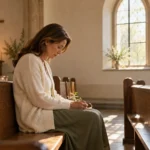
The framework is attributed to the linked USCCB and Vatican sources. The timed example, prompts, and sample prayers are original. No modern Bible translation text is reproduced. The image is an original AI-generated illustration.