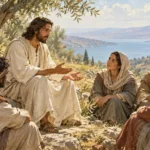
Psalm 121 expresses trust in the Lord as the source of help and the guardian of life. Its eight verses move from a question about help to reassurance about God’s watchful care. Read it as a prayer of trust, not a formula that makes faithful people immune to illness, accidents, or sorrow.
This guide explains the psalm in four verse pairs, then offers questions and an original prayer. The explanations are paraphrases, not quotations from a Bible translation. Begin by reading the complete Psalm 121, including the notes, so you can distinguish the biblical text from the reflections here.
A song for the journey
Psalm 121 belongs to the Songs of Ascents, Psalms 120–134. In his Working Preacher commentary, W. H. Bellinger Jr. connects this collection with pilgrimage to Jerusalem and reads the psalm’s journey imagery as an expression of trust amid danger. That is an interpretation of its setting, not a complete biography of its unknown speaker.
The journey offers a useful devotional starting point: what lies ahead of you today? It might be a literal trip, a conversation you have avoided, or a responsibility you cannot postpone. You do not need to pretend that the road is easy before bringing it to prayer.
Psalm 121 explained in four verse pairs
Verses 1–2: Who is the source of help?
The speaker looks toward the mountains and asks where help will come from. Verse 2 identifies the Lord, who made heaven and earth, as the source.
Commentators differ about the mountains. The USCCB notes consider both Zion and a dangerous landscape, favoring the latter. The Zondervan Academic commentary, drawing on W. Dennis Tucker Jr., favors an association with Zion. Neither interpretation makes the mountains themselves the source of help. Keep the question and its answer together.
Reflect: What am I asking God to help me face, and what ordinary support could I receive? Name the concern plainly. “Help me ask the questions I need to ask at this appointment” is more concrete than trying to feel certain about the entire future.
Verses 3–4: A guardian who does not sleep
The imagery turns to a foot kept steady and a guardian who remains awake. The reference to Israel places the individual reassurance within the life of God’s people.
Reflect: Where have I confused constant vigilance with responsibility? You may need to make a plan or respond to a genuine problem. You do not have to rehearse every possible disaster through the night. If worry keeps returning, ask what can be addressed today and who can help you carry it.
Verses 5–6: Care through day and night
The Lord is described as shade nearby. Sun and moon extend the picture across day and night: the psalm presents care that is not limited to a single moment.
Reflect: What would care look like in the next part of my day? It could be taking a necessary break, accepting a ride, or asking someone to accompany you. These are suggested responses, not coded meanings hidden in the words about sun and moon.
Verses 7–8: Coming and going
The closing blessing speaks of protection from evil and care for the person’s life, departures, and arrivals, extending into the future.
Reflect: What am I leaving, and what am I entering? Write one sentence for each. You might be leaving a familiar job and entering uncertainty, or leaving a difficult conversation and returning to ordinary responsibilities. Bring both parts to prayer rather than requiring yourself to have only one feeling.
Does the psalm mean nothing bad will happen?
Its protection language is strong. Do not quietly replace that strength with a vague claim that life is generally pleasant. At the same time, do not use the psalm to accuse a suffering person of insufficient faith. Bellinger’s commentary holds its confident portrait of God alongside biblical laments that speak honestly about apparent absence and urgent need.
Our devotional application is to pray for help without claiming to know the outcome. You can ask for safe travel while wearing a seat belt, ask for healing while receiving medical care, and seek protection while leaving an unsafe situation. Prayer is not a reason to abandon appropriate precautions or support.
If someone has just received painful news, listening may be kinder than offering an immediate explanation. You could say, “I would like to pray with you if you want. What would help right now?” Let their answer guide the care you offer.
A short original prayer inspired by Psalm 121
Lord, You know the road before me and the concern I am carrying. I ask for Your help with the next step. Give me wisdom to prepare, humility to receive support, and courage where I am afraid. Care for the people I love in their coming and going. When I cannot see how things will unfold, help me remain honest in prayer and attentive to the good I can do today. Through Jesus Christ, amen.
This is an original Christian prayer, not the text of Psalm 121 or a prescribed liturgical prayer. Change the words to fit your situation; no special wording or number of repetitions guarantees an outcome.
Read, notice, and respond
- Read all eight verses. If you need help beginning, use an opening prayer before Bible reading.
- Notice one image. Choose help, wakefulness, shade, or coming and going. Write what the passage says before adding your application.
- Bring one concern. Use your own words or the prayer above.
- Choose one act of care. Ask a question, accept help, or check in with someone. Return to the passage without turning it into a test of how calm you feel.
For a specific family application, our prayers for your husband’s everyday needs include reflection on Psalm 121. If you would welcome others praying for a concern, you can share a personal prayer request, using only details you are comfortable sharing.
Sources and interpretation
Scripture and notes were checked on the USCCB’s Psalm 121 page; additional interpretations were checked in Bellinger’s Working Preacher commentary and Zondervan Academic’s commentary on October 14, 2026. These sources have different editorial and denominational settings. The biblical explanations above are original paraphrases; the reflection questions, practical examples, and prayer are our original devotional material. No Bible translation text is reproduced.