The Mary Undoer of Knots novena is a Catholic devotion for bringing the tangled concerns of life to God through Mary’s intercession. For the published nine-day prayer text, use Pray More Novenas’ Mary Undoer of Knots novena. Below you will find an explanation of the devotion, a way to begin, and nine original daily reflections.
The reflections and prayers on this page are a companion written for this guide. They are not a reproduction of the established daily texts. You can use them alongside the published novena to reflect on your intention and the next faithful action available to you.
What does “Undoer of Knots” mean?
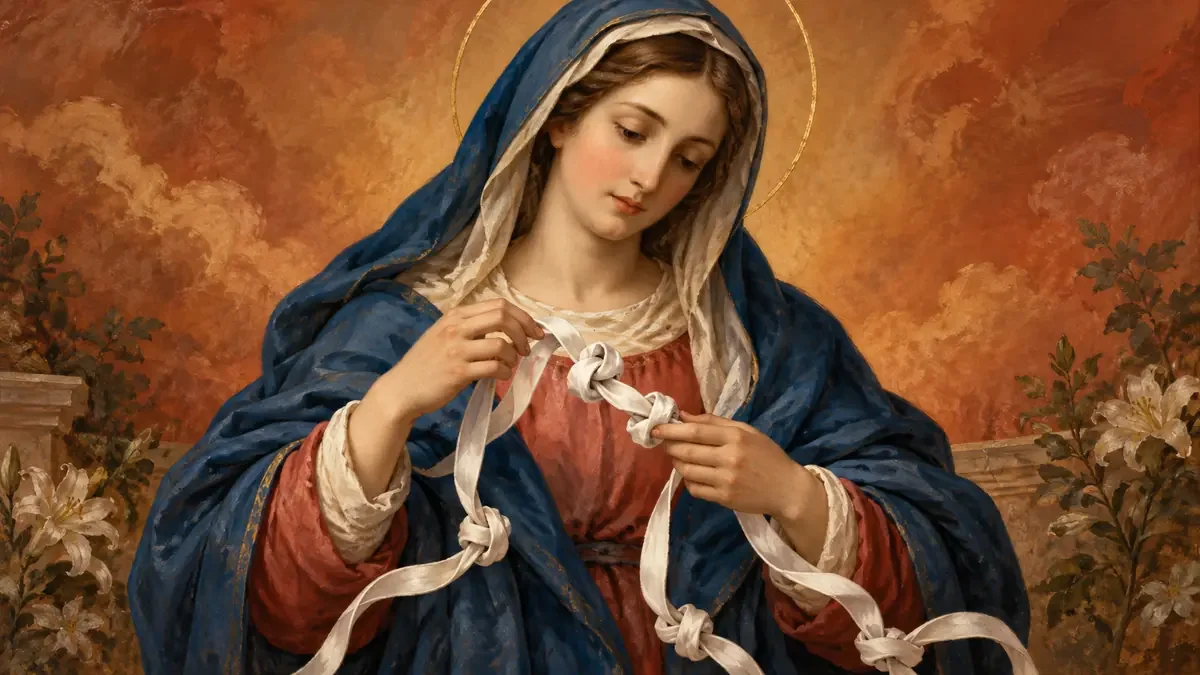
The knot is an image for what is tangled, difficult, or bound up in life. In this devotion, it can express the effects of sin as well as a concern you are struggling to understand or resolve.
In his 2013 address on Marian faith, Pope Francis discussed the image through Saint Irenaeus’ comparison of Eve’s disobedience with Mary’s obedience. The theological image concerns faith and God’s saving work, rather than a claim that a devotional object controls events.
You might bring a family disagreement, a difficult habit, an unresolved decision, grief, or a concern for someone you love. Try to describe the intention plainly. “Help us communicate truthfully about this problem” is easier to reflect on than a demand that another person must behave exactly as you wish.
How to pray the novena
- Choose one intention. Write a sentence naming the concern and the people affected.
- Open the published daily prayers. Follow the nine-day text at Pray More Novenas, or the form recommended by your parish.
- Pray the day’s text attentively. Insert your intention where the chosen form invites it.
- Pause for reflection. You may use the original companion below and read its Scripture passage.
- Choose a responsible response. Consider a conversation, a boundary, a request for advice, or another useful step.
Some prayer books include additional practices, so follow the particular form you have chosen. You do not need to combine every version you find online. If an instruction is unclear, a priest or parish adviser can help you understand it.
Nine days of original reflections and prayers
Keep the same intention before you. The daily themes are suggestions for reflection, not claims about what must happen on each day of the novena.
Day 1: Name the knot
Read: Psalm 139:23–24. Begin with a request for honest guidance. Describe the concern without exaggerating it or minimizing the pain it causes.
Reflect: What is the problem, and which parts of it are still unclear?
Father, I bring You this tangled concern. Help me see it honestly and speak about it clearly. Through Mary’s intercession, give me humility to recognize what I know, what I do not know, and where I need help. Amen.
Day 2: Ask for wisdom
Read: James 1:5. Wisdom may involve learning, asking a better question, and listening to someone with relevant experience. Identify a source of guidance you can approach.
Reflect: What information or advice would help me respond responsibly?
God of wisdom, guide me through this situation. Help me ask good questions, seek trustworthy counsel, and avoid rushing from fear. Through Mary’s intercession, give me patience to learn and courage to act on what becomes clear. Amen.
Day 3: Make room for patience
Read: Romans 12:9–13. The passage places patience, prayer, and practical generosity within a life of love. Waiting does not have to mean abandoning the concern.
Reflect: What useful thing can I do while an answer is still pending?
Lord, help me wait without becoming careless or harsh. Give me a steady rhythm of prayer and the willingness to do what is available today. Through Mary’s intercession, teach me patience that remains attentive to the people involved. Amen.
Day 4: Be honest about resentment
Read: Ephesians 4:25–32. The passage connects truthful speech, anger, kindness, and forgiveness. Start by naming what hurt; pretending it did not matter will not make the conversation clearer.
Reflect: What am I holding onto, and what would honest repair require?
God, You know the resentment I am carrying. Help me tell the truth about what happened without feeding cruelty or revenge. Through Mary’s intercession, give me wisdom about repair, the courage to seek support, and words that respect the dignity of everyone involved. Amen.
Day 5: Consider forgiveness carefully
Read: Colossians 3:12–15. Forgiveness belongs within compassion and patience. Reflect on your own response without assuming trust can be instantly restored or another person’s choices are yours to control.
Reflect: What would a faithful response look like, and what still needs time?
Father, lead me toward forgiveness with honesty and care. Help me release the wish to retaliate while still recognizing what needs repair. Through Mary’s intercession, give me patience with this process and discernment about the relationships before me. Amen.
Day 6: Recognize your responsibilities and limits
Read: Galatians 6:1–5. The passage speaks about helping with burdens and taking responsibility. Consider what you can do, what belongs to someone else, and where shared support is needed.
Reflect: What is mine to carry, and what do I need help carrying?
God of compassion, help me care without pretending I can control every outcome. Give me courage to set a wise boundary and generosity to offer appropriate help. Through Mary’s intercession, guide me toward responsibilities I can carry faithfully and support I can receive. Amen.
Day 7: Continue with a small faithful step
Read: Philippians 4:6–9. Prayer, attention, and practice appear together. Instead of trying to resolve the whole intention today, choose one action that is useful and possible.
Reflect: What small step would make the situation clearer or offer real care?
Lord, guide the next step rather than my every imagined outcome. Help me act truthfully, ask for what is needed, and remain open to correction. Through Mary’s intercession, give me courage for a small faithful action today. Amen.
Day 8: Notice the support you have received
Read: Psalm 103:1–5. The psalm begins in gratitude for God’s care. Name a person, conversation, or opportunity that has supported you during these days.
Reflect: What good has been present alongside the unresolved concern?
Father, thank You for the help I have received and the people who have stayed close. Keep me attentive to their kindness. Through Mary’s intercession, help gratitude make room for hope without asking me to deny what is still difficult. Amen.
Day 9: Entrust what remains
Read: Luke 1:26–38. Return to Mary’s willing response within a story that includes uncertainty. Review the intention and identify how you will continue after the ninth day.
Reflect: What has become clearer, and what faithful response will I keep practicing?
God, I place this intention before You again as the nine days end. Thank You for what I have learned, and guide me where questions remain. Through Mary’s intercession, keep me close to Christ and help me continue with wisdom, patience, and love. Amen.
When the concern is still unresolved
The ninth day is the end of a prayer pattern, not a deadline by which a relationship, illness, or decision must be settled. You can keep praying while taking practical steps and accepting appropriate support.
If the intention involves another person, remember that their choices remain their own. If it involves harm or an unsafe situation, prayer can accompany seeking help and protecting your safety. A devotion does not require ignoring the facts in front of you.
For a companion reading about repeated worry, explore Bible verses for overthinking. For another Marian devotion, see our Miraculous Medal novena guide.
Questions about Mary Undoer of Knots
Where can I find the established daily prayer text?
The Pray More Novenas page presents all nine days. A parish may recommend another published prayer book. The prayers on this page are clearly identified as an original companion.
What kind of intention can I bring?
You can pray about a difficult concern affecting your life or someone you love. Name it plainly, respect other people’s privacy, and ask for God’s guidance rather than a way to override another person’s will.
Do I need a picture of Mary untying knots?
An image can help focus a devotion, but you can pray without one. The significance lies in prayer and faith, rather than owning a particular picture.
What if I miss a day or do not feel different afterward?
You can return attentively and finish your intended days. A feeling is not the only way to assess the practice. Notice whether you have become clearer about your concern, more willing to seek help, or more attentive to a responsible next step.