
Jesus’ prayer in the Garden of Gethsemane is an honest prayer of anguish and trust before his arrest. He asks the Father about the suffering before him and expresses his willingness to follow the Father’s will. The scene is told in Matthew 26:36–46, Mark 14:32–42, and Luke 22:39–46.
“nevertheless not as I will, but as thou wilt” — Matthew 26:39, KJV
Read the prayer within the story of Jesus’ passion. It is more than a general lesson about staying calm: it shows Jesus facing the events that lead to his death, praying to the Father, and asking his disciples to remain watchful.
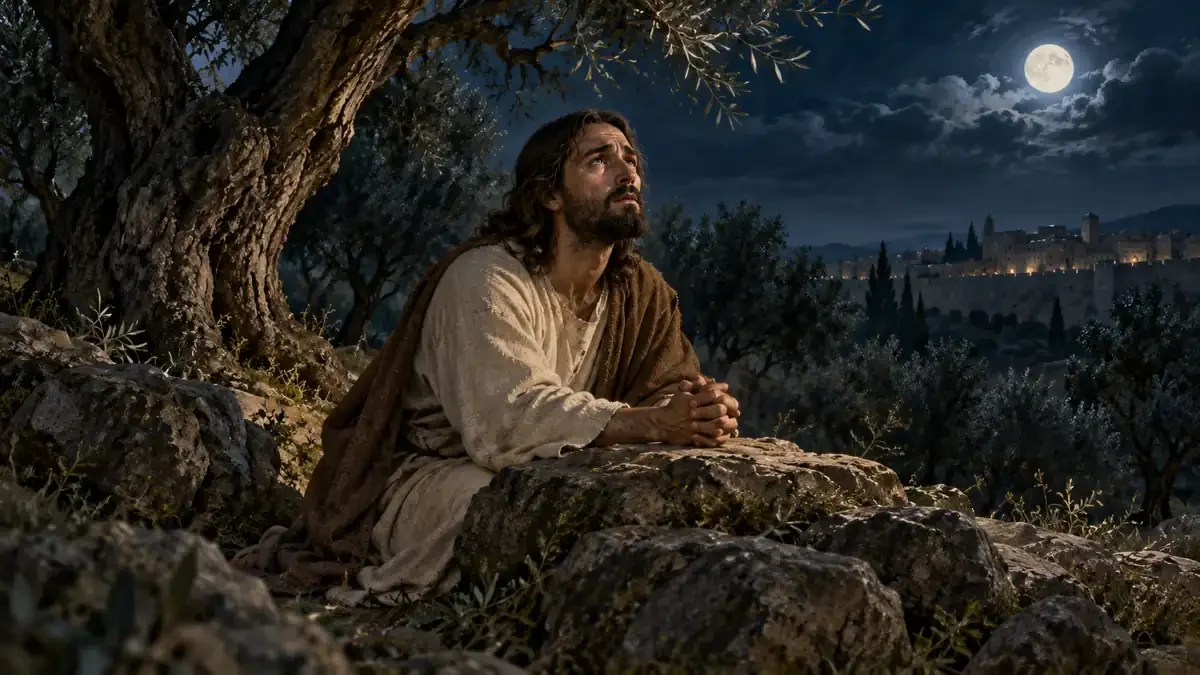
Where to read the garden prayer in the Bible
These three accounts describe the same setting with different emphases. Read each complete passage before combining their details.
| Gospel passage | Details to notice |
|---|---|
| Matthew 26:36–46 | Gethsemane is named. Jesus takes Peter and the sons of Zebedee farther with him, describes his sorrow, prays, and returns to the sleeping disciples. |
| Mark 14:32–42 | Peter, James, and John are named. Jesus addresses God as “Abba, Father” and asks about the cup before expressing surrender. |
| Luke 22:39–46 | The Mount of Olives is named. Jesus kneels to pray, and Luke says the disciples are sleeping from grief. |
John 17 is another important prayer of Jesus, but it is a distinct passage before the arrest. If you are looking specifically for the prayer about the cup and the Father’s will in the garden, begin with the three passages above.
What Jesus’ prayer expresses
He brings his distress to the Father
Matthew and Mark do not portray Jesus as emotionally untouched by what is coming. The scene makes room for sorrow and a direct request. In Mark’s account, the address to the Father places that request within a relationship of trust.
For a reader learning to pray, a thoughtful application is that honesty belongs in prayer. You can name fear, grief, and what you wish would change. You do not have to begin by sounding as if the difficulty has already been resolved.
He asks and surrenders within the same prayer
The request about the cup and the willingness to follow the Father’s will belong together. Matthew records Jesus praying again, including the words:
“thy will be done” — Matthew 26:42, KJV
The narrative’s surrender is costly. A personal reflection on it should leave room for both asking for help and acting responsibly. In your own circumstances, trusting God can include seeking care, obtaining advice, and making a difficult decision.
He returns to prayer
The repeated prayer in Matthew and Mark shows a scene that unfolds over time. Jesus does not utter one sentence and then immediately leave. You may find it helpful to return to an honest prayer when a concern remains, without treating repetition as a technique that forces an outcome.
What does “this cup” mean?
The cup is an image within the biblical story, not a physical drinking vessel that the garden scene requires us to picture. In this setting it points toward the suffering and death Jesus is facing.
Compare Mark 10:35–45, where Jesus uses the image of drinking his cup while speaking with James and John about what lies ahead. Reading those passages together helps keep the garden prayer connected to his mission.
You can ask a careful question as you read: “What is the image doing in this story?” That is more useful than immediately assigning the cup to any difficulty in your own life. Jesus’ passion is the primary setting; personal application follows from understanding it.
Why are the disciples sleeping?
In Mark, their eyes are heavy; Luke describes their sleep in connection with grief. The scene holds together human limitation and the call to remain alert. Jesus asks them to watch and pray as the crisis approaches.
“Watch ye and pray” — Mark 14:38, KJV
A useful reflection is to consider how you respond when someone you love is distressed. You may want to help and still be tired, distracted, or unsure what to say. Rather than imagining you can offer unlimited support, ask what attentive companionship would look like in a concrete moment.
It might mean putting down your phone for a conversation, asking when a check-in would help, or acknowledging that you cannot solve the person’s problem but can remain present. Our prayers for healing for a friend include ways to offer prayer and practical companionship together.
A note about the angel and the sweat in Luke
Some Bible editions bracket or footnote Luke 22:43–44, the verses about an angel strengthening Jesus and his sweat being like drops of blood. The USCCB notes on Luke 22 explain that these verses are absent from some early manuscripts.
That explains why editions may present the detail differently. Read your Bible’s footnote rather than assuming a missing or bracketed verse is a printing error. The devotional point of the scene can be explored without trying to make a medical diagnosis from its imagery.
Four questions for a quiet reflection
- What do I notice in the text? Identify Jesus’ words, the disciples’ response, and what happens next.
- What am I afraid to say in prayer? Name one honest concern without polishing it.
- What response is available to me? Consider a responsible action, a request for help, or a needed conversation.
- Who needs my attention? Think about someone to whom you can offer a small, specific act of care.
Keep the questions connected to the passage. You are reflecting on a particular Gospel scene, not trying to find a hidden answer to every decision within it.
An original prayer inspired by Gethsemane
This prayer is for your own reflection. It is not presented as additional words spoken by Jesus.
Father, I bring You the concern I find hard to face. I ask for help, for relief, and for a wise path through it. Keep me honest about my fear and open to the support I need. As I remember Jesus praying in Gethsemane, help me trust You without turning away from my responsibilities. Give me courage for the next faithful step and tenderness toward the people beside me. Teach me to pray again when words come slowly. Through Jesus Christ, amen.
Questions about Jesus’ prayer in the garden
Was Jesus praying alone?
He went to the place with his disciples and then withdrew to pray. Matthew and Mark name the three disciples who went farther with him; the accounts also describe his return to the sleeping disciples.
Does the prayer mean I should never ask God to change a situation?
No. The garden prayer itself includes a request. You can bring a situation honestly to God and ask for help while remaining open to wise guidance and a responsible response.
Is the prayer in John 17 the Gethsemane prayer?
John 17 records a different prayer before the arrest. The garden prayer about the cup is found in Matthew 26, Mark 14, and Luke 22.
How can I begin reading this scene?
Choose one Gospel account, read it slowly, and notice its own details. Then compare a second account. Our prayers before reading the Bible offer a short opening prayer for that kind of attentive study.